COURSE DESCRIPTION
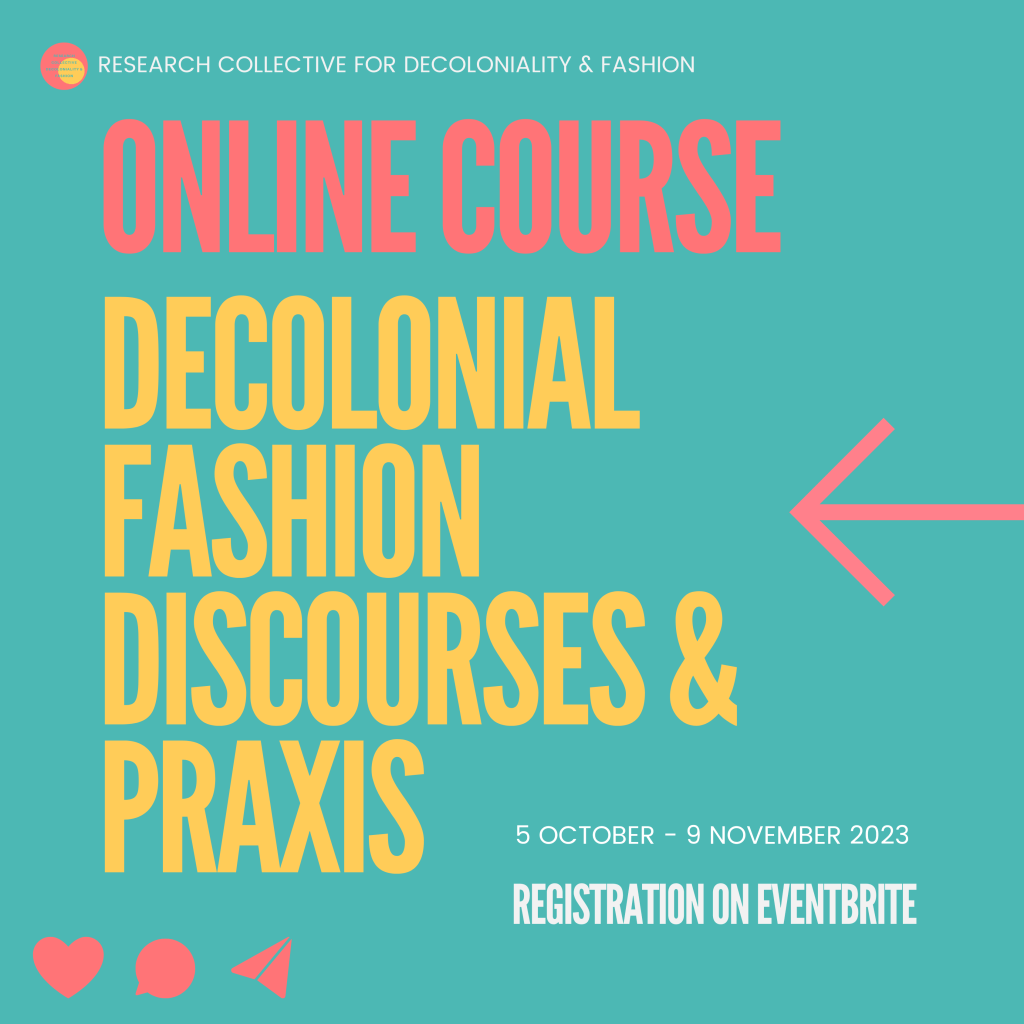
This online course explores both theoretical and practice-based aspects of decolonial fashion discourses and practices. It provides participants with an exciting collaborative opportunity to explore a range of approaches, mediums and practices that will strengthen their position to disrupt dominant eurocentric fashion and formulate inclusive, diverse and sustainable alternatives.
The course is aimed at students, researchers, critical thinkers, activists, practitioners and concerned citizens who are committed to undoing the exploitive and destructive logics of the contemporary fashion industry. We welcome participants from all walks of life, with or without a background in fashion. The sessions are in English and consist of 1.5 hours, of which 1 hour lecture and 30 min group discussion. Organised around six topics, the course examines some key problems the contemporary fashion industry is facing today. The focus is on knowledge transmission, but we aim to learn from each other, with each other. The course is convened by some of the most exciting decolonial + fashion thinkers, including Rolando Vazquez, Sandra Niessen, Sarah Cheang, Erica de Greef, Angela Jansen and Benjamin Wild.
COURSE DETAILS
- Duration: 6 online sessions via ZOOM, once a week, on Thursday evenings at 8-9h30pm CET.
- Commitment: participants are expected to come to class prepared, having prepared the selected materials. There is a (free format) final assignment which can be a writing, drawing, video, audio or object.
- Course fee: 150€ (one scholarship per course is available).
- Registration: Before 21 September 2023 on Eventbrite (max of 20 participants).
- Contact: info@rcdfashion.com
COURSE OUTLINE
Session 1 (5 October 2023): Introduction to decolonial fashion discourses and praxis, by Angela Jansen & Benjamin Wild
In this session, we will present the course outline, its decolonial framework of knowledge creation and sharing and our positionalities and responsibilities. We will provide an overview of some of the major crises the contemporary fashion industry is facing and its roots in the modern civilization project. Participants will be encouraged to share their interests in decoloniality and fashion.
Session 2 (12 October 2023): Modernity/coloniality/decoloniality & fashion, by Rolando Vazquez (tbc) & Angela Jansen
Other than decolonization, which is the historical struggle for national sovereignty and the restitution of stolen indigenous lands, decoloniality is the historical struggle for dismantling colonial ways of thinking and doing and the restitution of knowledges and histories that have been denied and erased by modernity. In this session we will be looking at some key propositions of decolonial thinking, including concepts of eurocentrism, anthropocentrism and contemporaneity. We will be unpacking modern fashion aesthetics, which have been playing a key role in configuring a canon, a normativity that enables the disdain and rejection of other forms of aesthetic practices.
Session 3 (19 October 2023): Decoloniality and fashion studies, by Sarah Cheang
Decolonial thinking provides an intervention into the coloniality of knowledge and value hierarchies in art and design. This can shift fashion studies in ways that challenge racism, by questioning the impact of colonial language, concepts and methods. As active participants, we will highlight the ways that ‘race’ figures at the intersections between research, teaching and museum practices, and think critically about how discussions of ‘race’ and coloniality occur in fashion studies, in order to more successfully counter rather than reinscribe injustice, and acknowledge and care for a wider range of cultural positions. Often, decolonial efforts struggle with the inescapable conditions of capitalist modernity. Embracing unresolved contradictions and paradoxes, we will give space to questions of process and being-in-process in challenging the racialized foundations of power and distinction encoded in fashion ideologies.
Session 4 (26 October 2023): Decoloniality and sustainable fashion, by Sandra Niessen
The accepted framework for sustainable fashion focuses on reducing the throughputs of the industry: energy and materials. This framework rests on a definition of fashion as ‘style change through time’, which emphasizes the materiality of fashion seen through the lens of contemporaneity. Students will be invited to explore fashion as social and economic processes that create sacrifice zones and hierarchies that serve to exclude. Unless it is radically fair, a sustainability framework is bound to fail.
Session 5 (2 November 2023): Decoloniality and fashion curation, by Erica de Greef
This session brings together multimedia possibilities for exploring and confronting the colonial violence of fashion museums, to seek out decolonial affordances of these sites or their collections. Drawing on the embodied politics of remembering, the session invites participants to share a material counter-memory through poetry, photography, a reading, or a sonic fragment, and working together, the session aims to cohere these ‘fashion objects’ through a decolonial curatorial framework. Can ‘fashion objects’ tell alternate stories that speak from the global south, that offer decolonial options, and fill in the gaps of erasure and marginalisation?
Session 6 (9 November 2023): Decoloniality & a politics of redress, by Sandra Niessen & guests
This session will focus on the future of fashion. Redress demands radical transformation towards a global fashionscape that is ethical, and regenerative: a politics of redress. Radical fashion transformation asks for aesthetic and epistemic as well as ecological repair. How can we collectively bring about this transition? How can we work collectively towards a politics of aesthetic and epistemic restitution and repair? How can we collectively transition from a logic of representation and owning to a logic of reception and owing? How can we host and give back a place in the present, of hosting and emplacing what has been denied and erased?


 Research Collective for Decoloniality & Fashion
Leave a reply to Laurie Brewer Cancel reply